Currently Empty: R0.00


About Course
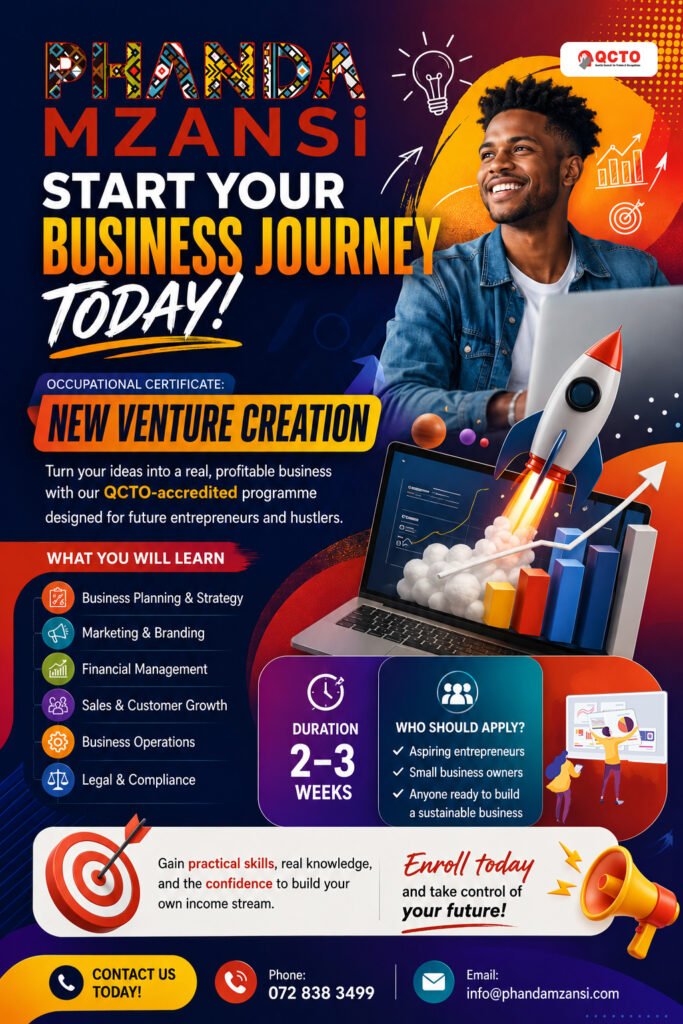
The purpose of the skills programme is to prepare candidates to operate small businesses. Learners who acquire this skills programme will be able to:
Start, manage, grow and sustain a small business.
What Will You Learn?
- By the end of this topic, learners will be able to:
- Understand the meaning of entrepreneurship and the role of an entrepreneur
- Identify the characteristics and responsibilities of successful entrepreneurs
- Explain how entrepreneurship contributes to economic growth and job creation
- Understand the risks and rewards involved in starting a business
- Recognise the importance of innovation, planning, and business opportunities
- Understand the basic resources required to start and operate a business
- Develop an entrepreneurial mindset and problem-solving approach
Course Content
Topic 1: Being An Entreprenuer
This topic introduces the concept of entrepreneurship and explains the important role entrepreneurs play in the economy. An entrepreneur is someone who starts and manages a business by taking risks in order to earn rewards and create opportunities. Entrepreneurship involves turning ideas, products, or services into successful businesses through innovation, planning, and initiative.
The topic also explains how entrepreneurs contribute to economic growth by identifying market needs, creating jobs, introducing new products or services, and driving business development. Learners will understand the responsibilities, risks, and rewards involved in starting and operating a business, as well as the key resources needed to run a successful enterprise.
-
Being An Entreprenuer
-
Being an entrepreneur questionnaire
Topic 2: Know Yourself
This topic explains the importance of knowing yourself as an entrepreneur. “Being yourself” in entrepreneurship means being authentic, honest, and realistic about who you are, what your business can offer, and what you are comfortable with. Entrepreneurs are encouraged to understand their strengths, weaknesses, values, and limits because self-knowledge helps build confidence, leadership, and better decision-making.
The topic also highlights that successful entrepreneurs are self-aware, genuine, and able to communicate clearly with others. Knowing yourself helps you create stronger relationships, make smarter business decisions, and understand when to say “no” to unnecessary pressure or responsibilities.
In addition, the topic discusses important entrepreneurial skills such as having a vision, asking questions, passion, energy, work ethic, communication, teamwork, and sales skills. Entrepreneurs who understand themselves are more likely to build the right business, attract the right team, improve themselves continuously, and lead others effectively.
-
Know Yourself
-
Know Yourself Questionnaire
Topic 3: Knowing Your Industry
This topic explains the meaning and importance of industry analysis in entrepreneurship and business. Industry analysis is a tool used to understand how an industry operates, including the level of competition, market demand and supply, technological changes, credit systems, and other external factors that affect businesses within the industry.
The topic highlights that industry analysis helps entrepreneurs and companies understand their position compared to competitors. It allows businesses to identify opportunities for growth as well as possible threats and challenges within the market.
By understanding the industry environment, entrepreneurs can make better business decisions, plan for future changes, and develop strategies that give them a competitive advantage. Knowing the differences between your business and your competitors is important for surviving and succeeding in a constantly changing business world.
-
Knowing Your Industry
-
Knowing Your Industry Questionnaire
Topic 4: Identifying Market Opportunities
In today’s fast-changing business environment, companies must continuously look for new market opportunities to remain competitive and profitable. Changes in technology, customer behaviour, and business models create both challenges and opportunities for growth.
To identify market opportunities successfully, businesses must first understand their goals, strengths, resources, and capabilities. They must then analyse the market by studying consumer needs, competitors, supply chains, regulations, and the overall business environment.
One important method of identifying opportunities is consumer segmentation, which involves grouping customers based on shared characteristics. These characteristics may include hard variables such as age, gender, income, occupation, and education level, or soft variables such as lifestyle, values, attitudes, and purchasing motivations.
Understanding consumer segments helps businesses estimate market demand, identify customer needs, and develop products or services that better satisfy specific target audiences. This process allows businesses to position themselves more effectively in the market and discover opportunities for business growth.
-
Identifying Market Opportunities
-
Identifying Market Opportunities Questionnaire
Topic 5: Innovation
Business innovation is the process where companies introduce new or improved ideas, products, services, or processes to increase growth, efficiency, and profitability. It focuses on creating value by solving business problems, improving how things are done, or developing entirely new offerings.
Innovation is not just about using new technology or making random changes it must directly improve the core business and contribute to growth or competitive advantage.
-
Innovation
-
Innovation Questionnaire
Topic 6: Customer Service
Customer service refers to the interaction between a customer and a company before, during, and after a purchase. It involves assisting customers with enquiries, resolving issues, and ensuring they have a positive experience with a product or service.
Good customer service is important for business success because it builds customer satisfaction, trust, and loyalty. When customers feel valued and supported, they are more likely to return and recommend the business to others.
Although many companies now use automated systems such as chatbots and online help centres, human interaction remains important, especially when dealing with complex issues or emotional concerns. A balance between technology and personal support is often the most effective approach.
Overall, customer service plays a key role in maintaining a strong brand reputation and ensuring long-term business growth.
-
Customer Service
-
Customer Service Questionnaire
Topic 7: Financial & Cash Flow Management
In this topic, learners will explore the concept of cash flow and its importance in financial management. The topic explains how cash moves in and out of a business and why monitoring cash flow is essential for maintaining business operations and long-term sustainability.
Learners will study the three main types of cash flow:
Cash flow from operating activities
Cash flow from investing activities
Cash flow from financing activities
The topic also introduces cash flow analysis and explains how businesses use it to evaluate liquidity, solvency, and overall financial health. Learners will gain an understanding of how companies analyse cash inflows and outflows to determine where money comes from and how it is being used.
In addition, the topic covers:
The relationship between profitability and cash flow
Why a profitable business can still experience negative cash flow
The importance of maintaining positive operational cash flow
How cash flow statements help businesses make financial decisions
Additional cash flow measurements such as free cash flow
By the end of this topic, learners will understand how cash flow analysis supports financial planning, business growth, and effective decision-making within an organisation.
-
Financial & Cash Flow Management
-
Financial & Cash Flow Management
Topic 8: Basic Business Financial Statements
In this topic, you will learn how businesses understand their financial health using key financial reports. These reports help owners, investors, and managers make informed decisions about money, performance, and future growth.
1. Understanding Financial Statements
You will learn what financial statements are and why they are important.
They are official records that show how a business is performing financially over time.
You will also learn the three main financial statements:
Balance Sheet
Income Statement
Cash Flow Statement
2. The Balance Sheet
You will learn how a business’s financial position is shown at a specific moment in time.
This includes:
What a business owns (assets)
What a business owes (liabilities)
The owner’s value in the business (equity)
You will also understand how to interpret whether a business is financially stable.
3. The Income Statement
You will learn how businesses measure profit or loss over a period of time.
This includes:
Revenue (money earned)
Expenses (money spent)
Net profit or net loss
You will understand how businesses calculate profit and why profit does not always equal available cash.
4. The Cash Flow Statement
You will learn how money actually moves in and out of a business.
You will study three key areas:
Operating activities (daily business operations)
Investing activities (buying or selling assets)
Financing activities (loans, investors, and funding)
You will also understand why a business can be profitable but still struggle with cash.
5. Cash Flow Analysis
You will learn how businesses analyse cash movement to understand financial stability.
This includes:
Tracking where money comes from
Tracking where money goes
Understanding liquidity (ability to pay short-term bills)
Understanding solvency (long-term survival)
6. Comparing Profit vs Cash Flow
You will learn the difference between:
Profit (what is earned on paper)
Cash flow (actual money available)
You will understand why both are important for running a successful business.
7. How Financial Statements Work Together
You will learn how the three statements are connected and support each other in showing the full financial picture of a business.
Outcome of This Topic
By the end of this topic, you will be able to:
Read and understand financial statements
Explain how businesses make profit
Understand how cash moves in a business
Analyse basic financial health using reports
-
Basic Business Financial Statements
-
Basic Business Financial Statements Questionnaire
Topic 9: Pricing of goods and services
What is the pricing of goods?
Pricing is a process of fixing the value that a manufacturer will receive in the exchange of services
and goods. Pricing method is exercised to adjust the cost of the producer's offerings suitable to both
the manufacturer and the customer.
What is product pricing?
Product pricing is the process of determining the quantitative value of a product based on both
internal and external factors. Product pricing has a direct impact on the overall success of your
business - from cash flow to profit margins to customer demand.
What Are Price Controls?
The term "price controls" refers to the legal minimum or maximum prices set for specified goods.
Price controls are normally mandated by the government in the free market. They are usually
implemented as a means of direct economic intervention to manage the affordability of certain goods
and services, including rent, gasoline, and food. Although it may make certain goods and services
more affordable, price controls can often lead to disruptions in the market, losses for producers, and
a noticeable change in quality.
● Price controls are government-mandated minimum or maximum prices set for specific goods
and services.
● Price controls are put in place to manage the affordability of goods and services on the
market.
● Minimums are called price floors while maximums are called price ceilings.
Page 75 of 94
● These controls are only effective on an extremely short-term basis.
● Over the long term, price controls can lead to problems such as shortages, rationing, inferior
product quality, and illegal markets.
How should I price my products?
There are a lot of articles and advice about product pricing. It’s easy to fall into a black hole if it’s
your first time pricing a product. Fortunately, there is a simple way to price products so that you sell
profitably.
Pricing touches everything from your business finances to your product’s positioning in the market
with considerations like whether it's timeless, bespoke, or a short-lived trending product. It also
factors into how you make a profit selling on online selling sites. It’s a key strategic decision you
need to make for your business, and it can be just as much an art as it is a science.
But it’s not a decision you only get to make once.
If you’re trying to find the retail price of your product, there is a relatively quick and straightforward
way to set a starting price. Remember, just because it’s the price you use to launch doesn’t mean
it’s the price you’ll use forever.
To set your first price, add up all the costs involved in bringing your product to market, set your profit
margin on top of those expenses, and there you have it. This strategy is called cost-plus pricing, and
it’s one of the simplest ways to price your product.
How to price your product
There are three straightforward steps to calculating a sustainable price for your product.
● Add up your variable costs (per product)
● Add a profit margin
● Don’t forget about fixed costs
Page 76 of 94
1. Add up your variable costs (per product)
First and foremost, you need to understand all the costs involved in getting each product out the
door. If you order products, you’ll have a straightforward answer as to how much each unit costs
you, which is your cost of goods sold.
If you make your products, you’ll need to dig a bit deeper and look at a bundle of your raw materials,
labour costs, and overhead costs. How much does that bundle cost, and how many products can
you create from it? That will give you a rough estimate of your cost of goods sold per item.
However, you shouldn’t forget the time you spend on your business is valuable, too. To price your
time, set an hourly rate you want to earn from your business, and then divide that by how many
products you can make in that time. To set a sustainable price, make sure to incorporate the cost of
your time as a variable product cost.
Here’s a sample list of costs you might incur on each product.
Cost of goods sold
Production time
Packaging
Promotional materials
Shipping
Affiliate commissions
Total per-product cost
In this example, your total per-product cost is R14.28.
R3.25
R2.00
R1.78
R0.75
R4.50
R2.00
R14.28
Wondering what kind of promotional materials you might need for your products? One of the most
common ones in an ecommerce context is marketing materials or additional gifts to level up
your ecommerce packaging and unboxing experience.
2. Add a profit margin
Page 77 of 94
Once you’ve got a total number for your variable costs per product sold, it’s time to build profit into
your price.
Let’s say you want to earn a 20% profit margin on your products on top of your variable costs. When
you’re choosing this percentage, it’s important to remember two things:
You haven’t included your fixed costs yet, so you will have costs to cover beyond just your variable
costs.
You need to consider the overall market and make sure that your price range still falls within the
overall “acceptable” price for your market. If you’re two times the price of all your competitors, you
might find sales become challenging depending on your product category.
Once you’re ready to calculate a price, take your total variable costs and divide them by 1 minus
your desired profit margin, expressed as a decimal. For a 20% profit margin, that’s 0.2, so you’d
divide your variable costs by 0.8.
In this case, that gives you a base price of R17.85 for your product, which you can round up to R18.
Target price = (Variable cost per product) / (1 - your desired profit margin as a decimal)
3. Don’t forget about fixed costs
Variable costs aren’t your only costs.
Fixed costs are the expenses that you’d pay no matter what, and that stays the same whether you
sell 10 products or 1,000 products. They’re an important part of running your business, and the goal
is that they’re covered by your product sales as well.
When you’re picking a per-unit price, it can be tricky to figure out how your fixed costs fit in. A simple
way to approach this is to take the information about variable costs you’ve already gathered and set
them up in this break-even calculator spreadsheet. To edit the spreadsheet, go to File > Make a
copy to save a duplicate that’s only accessible by you.
It’s built to look at your fixed costs and your variable costs in one place, and to see how many units
you’d need to sell of a single product to break even at your chosen price. These calculations can
help you make an informed decision about the balance between covering your fixed costs and setting
a manageable and competitive price.
Find out everything you need to know about performing a break-even analysis, including what to
watch out for and how to interpret and adjust based on your numbers.
Page 78 of 94
How to Price Your Product in 5 Steps
Setting prices that allow your business to sustain itself is essential to continued success and growth
as a company. Thankfully, it's quite feasible to create a practical pricing model. Here's how to do it:
1. Study the market. If you're bringing a new product into an existing market, you need to research
price points for similar products. Customers will have an inherent sense of fair product pricing within
your sector, and you need to meet their expectations. If you plan to vary drastically from your
competitors' prices, there should be a clear reason for doing so. In the world of easy online searches,
always assume that the public is aware of how much your competitors charge.
2. Assess your costs. On an ongoing basis, a business must cover both fixed costs and variable
costs that go into making their product. Fixed costs include things like real estate leases, insurance
payments, and annual taxes that some businesses owe to states regardless of income. Variable
costs depend on the number of products you manufacture; they include raw materials and labour
costs (employee wages plus benefits). There may also be costs from the product development
process that you need to pay down. These all combine to form your total cost.
3. Decide how your product will be sold. If you plan to sell your product yourself via an online
store or your own shop, you'll be going directly to the consumer. If you sell your product to a retail
store, the store will add cost to cover their own bottom line—a model known as cost-plus pricing. If
your product is in stores, those retailers won't want you undercutting them by offering lower prices
online. A simple way to address this is to either mark up the price of the product on your own website
(so that it matches the in-store retail price). Alternatively, you can opt to only sell in either retail stores
or direct-to-customer. Many retailers won't allow you to do both.
4. Decide whether you're aiming for the high-end, middle, or low-end consumer. Different prices
connote different messages about your product or service. A higher price may imply that your
product has a higher value, but it may repel savvy bargain hunters or potential customers with limited
incomes. Lower prices may (fairly or unfairly) imply lower quality, but a low product price can often
lead to a high sales volume. Meanwhile, a middle-of-the-road price suggests a standard-issue,
reliable product. This can work for certain types of goods (like groceries) and services (like auto
repair). On the other hand, a mid-tier pricing structure lacks both the high profit margins of the luxury
market and the massive volume of the bargain market.
Page 79 of 94
5. Monitor progress over time. Most small business owners need time to assess the true market
value of their goods or services. To succeed in the long run, you'll need to monitor sales and see if
the dollar amount you've assigned to your product comports with the dollar amount the public is
willing to pay. If it's hard to keep up with demand, you may have a reason to raise your prices. If
sales are low, you may have to offer a sale price (or slash the normal retail price) to establish a
customer base. The most successful businesses respond ably to market trends. Pay attention to
your customers; if you can continually address their needs while maintaining the necessary cash
flow, you can count on a long, prosperous lifespan for your product.
-
Pricing of goods and services
-
Pricing of goods and services
Topic 10: Marketing
-
Marketing
-
Marketing Questionnaire
Topic 11: SMART GOALS
n this topic, you will learn how to set clear, structured, and achievable goals using the SMART framework. SMART goals help you plan effectively, stay focused, and increase your chances of success in both business and personal life.
1. Understanding Goals
You will learn what goals are and why they are important.
This includes:
How goals provide direction and motivation
How goals help you focus on what matters
Why setting targets improves performance and success
2. What SMART Goals Are
You will learn what the SMART system means in goal setting.
SMART stands for:
S – Specific
M – Measurable
A – Achievable
R – Realistic
T – Timely
You will understand how each part helps turn vague ideas into clear action plans.
3. Specific Goals
You will learn how to make goals clear and well-defined.
This includes answering:
Who is involved?
What do I want to achieve?
Where will it happen?
When will it happen?
Why is it important?
You will learn how clarity improves success rates.
4. Measurable Goals
You will learn how to track progress.
This includes:
Setting measurable indicators of success
Knowing how to track improvement
Understanding when a goal has been achieved
5. Achievable Goals
You will learn how to set realistic challenges.
This includes:
Checking if you have the skills and resources needed
Identifying what support or tools you may need
Setting goals that stretch you without being impossible
6. Realistic Goals
You will learn how to ensure goals make sense in real life.
This includes:
Matching goals with available time and resources
Setting goals that are practical and possible
Avoiding unrealistic expectations
7. Timely Goals
You will learn the importance of deadlines in goal setting.
This includes:
Setting a clear start and end date
Creating urgency and motivation
Avoiding delays and procrastination
Outcome of This Topic
By the end of this topic, you will be able to:
Explain what SMART goals are
Set clear and structured goals using the SMART method
Break down big goals into manageable steps
Track progress and stay motivated
Improve personal and business planning skills
-
SMART GOALS
-
SMART GOALS Questionnaire
Topic 12: Business Planning
In this topic, you will learn how businesses create structured plans that guide their operations, growth, and financial success. A business plan is a roadmap that shows where the business is going and how it will get there.
1. Understanding a Business Plan
You will learn what a business plan is.
This includes:
A written document outlining business goals
A roadmap for operations, marketing, and finances
A tool used by both start-ups and existing businesses
A guide for internal decision-making and external funding
2. Purpose of a Business Plan
You will learn why business plans are important.
This includes:
Helping businesses plan and organise ideas
Attracting investors and funding
Securing loans from financial institutions
Reducing risks by planning ahead
3. Key Sections of a Business Plan
You will learn the main parts of a business plan.
These include:
Executive Summary – overview of the business and mission
Products & Services – what the business offers
Market Analysis – understanding customers and competitors
Marketing Strategy – how the business will attract customers
Financial Planning – income, expenses, and projections
Budget – cost planning for business operations
4. Business Plan as a Living Document
You will learn that a business plan is not fixed.
This includes:
Updating goals regularly
Reviewing performance over time
Adjusting strategies based on results
Keeping the business aligned with market changes
5. Financial Planning in Business
You will learn how financial planning supports a business plan.
This includes:
Sales forecasting (predicting future sales)
Cash flow analysis (tracking money in and out)
Budget planning (managing business costs)
Ensuring long-term profitability
6. Contingency Planning
You will learn how businesses prepare for risks and emergencies.
This includes:
Planning for disasters or unexpected events
Ensuring business survival during crises
Protecting employees, customers, and assets
Maintaining operations during disruptions
7. Business Succession Planning
You will learn how businesses plan for leadership changes.
This includes:
Preparing for retirement or ownership transfer
Avoiding conflict in family or business transitions
Ensuring business continuity
8. Steps in Creating a Business Plan
You will learn a structured process for building a business plan:
Research the market and industry
Develop a strategy
Create financial forecasts
Draft the business plan
Review and revise
Present the final plan
Outcome of This Topic
By the end of this topic, you will be able to:
Explain what a business plan is and why it matters
Identify the key sections of a business plan
Understand how financial planning fits into business strategy
Recognise how businesses prepare for risks and growth
Outline the steps to create a basic business plan
-
Business Planning
-
Business Planning Questionnaire
Instructors
P

No Review Yet